What is Wellness Pilipinas?

The Philippines' response to the call of World Health Organization (WHO) in 2009
to lessen the augment of Lifestyle Diseases of stroke, cancer, diabetes, etc, and the country's compliance to United Nations Climate Change Peace Building Campaign in 2007. Wellness Pilipinas! was conceived by "Wellness for Peace" Author, Public Speaker & former Peace Ambassador Zara Jane Juan. It consists of pep talks, workshops, symposiums & fora meant to achieve wellness in mind, body, spirit & economics as tools for peace & nation-building. Wellness Pilipinas aired as a live TV show at GNN via G-SAT Asia from 2009-2010 supported by private and public corporations

Innovating Peace by Amb Zara Jane Juan

Innovating Peace by Amb Zara Jane Juan
Wellness for Peace Education

WELLNESS PILIPINAS INTERNATIONAL

Translate

Tuesday, January 21, 2020

WHO: Thirteenth general programme of work 2019−2023

Major global health gains have been made in recent years, yet complex, interconnected threats − from poverty and inequality to conflict and climate change – remain.


Based on the Sustainable Development Goals, the 13th General Programme of Work (GPW) sets out WHO’s strategic direction for the next five years. It also outlines how the Programme will be implemented and provides a framework to measure progress.


The central focus of GPW 13 is impact in countries. It articulates WHO’s mission to promote health, keep the world safe and serve the vulnerable.


GPW 13 is structured around key interconnected strategic priorities:
ensuring healthy lives and well-being for all at all ages;
achieving universal health coverage;
addressing health emergencies and promoting healthier populations.


These priorities are linked to three bold targets:

One billion more people to benefit from universal health coverage.
One billion more people better protected from health emergencies; and,
One billion more people enjoying better health and well-being.


They are supported by three strategic shifts:

stepping up leadership;
driving public health impact in every country; and,
focusing global public goods on impact.


WHO is committed to ensuring gender equality, equity and rights-based approaches to health that enhance participation, build resilience and empower communities.


Making WHO fit-for-purpose

To boost impact for the people we serve, WHO announced the most wide-ranging reforms in the Organization’s history in March 2019.

WHO’s transformation, aligned with the wider United Nations reform agenda, also aims to enhance our normative and technical work to ensure it better meets the needs of all 194 Member States.

Our goal is clear - to make WHO a modern organization that works seamlessly to make a measurable difference in people’s health at country level.

There are five key elements:
The GPW
A new operating model
Fit-for-purpose processes and tools
Organizational culture and staff engagement
New external engagement actions and new partnerships


After establishing our new strategy, the GPW13, we embarked on a radical redesign of our core processes and operating model to enable our vision of a WHO that works seamlessly to deliver on the triple billion targets and beyond.WHO Headquarters adopts the new structure in January 2020, and Regional and Country Offices are restructuring and aligning to the new model.


The Seventy-first World Health Assembly has approved WHO's 13th General Programme of Work (GPW13).
Thirteenth general programme of work, 2019-2023
Also available in: Arabic, Chinese, French, Russian, Spanish
Triple Billion Targets: Results Report 2018-19
Draft Proposed programme budget 2020–2021
Draft Working Document on the Operationalization of the Proposed Programme Budget 2020-2021
Information Note on the Budgetary Aspects of Polio Eradication and Polio Transition
Proposed programme budget 2020-2021

https://www.who.int/about/what-we-do/thirteenth-general-programme-of-work-2019---2023

Thursday, November 14, 2019

Mosquito sterilization offers new opportunity to control chikungunya, dengue, and Zika -WHO

14 November 2019
News release

A technique that sterilizes male mosquitoes using radiation will soon be tested as part of global health efforts to control diseases such as chikungunya, dengue, and Zika.

The Sterile Insect Technique (SIT) is a form of insect birth control. The process involves rearing large quantities of sterilized male mosquitoes in dedicated facilities, and then releasing them to mate with females in the wild. As they do not produce any offspring, the insect population declines over time.

The Special Programme for Research and Training in Tropical Diseases (TDR) and the International Atomic Energy Agency (IAEA), in partnership with the Food and Agriculture Organization of the United Nations (FAO), and WHO have developed a guidance document for countries that have expressed interest in testing the Sterile Insect Technique (SIT) for Aedes mosquitoes.
Half the world at risk of dengue

“Half the world’s population is now at risk of dengue,” said Dr Soumya Swaminathan, WHO Chief Scientist. “And despite our best efforts, current efforts to control it are falling short. We desperately need new approaches and this initiative is both promising and exciting.”

In recent decades, the incidence of dengue has increased dramatically due to environmental changes, unregulated urbanization, transport and travel, and insufficient sustainable vector control tools and their application.

Dengue outbreaks are currently occurring in several countries, notably on the Indian sub-continent. Bangladesh is facing the worst outbreak of dengue since its first recorded epidemic in 2000. The South Asian nation has seen the number of cases rise to over 92,000 since January 2019, with daily admissions peaking at more than 1,500 new dengue patients in hospitals in recent weeks and is one of the countries to express interest in the Sterile Insect Technique.

Diseases transmitted by mosquitoes such as malaria, dengue, Zika, chikungunya, and yellow fever account for about 17% of all infectious diseases globally, claiming more than 700,000 lives each year, and inflicting suffering on many more. The 2015 outbreak of Zika in Brazil was linked to an increase in the number of babies being born with microcephaly.
New technique proved successful against insects that attack crops and livestock

The Sterile Insect Technique was first developed by the U.S. Department of Agriculture and has been used successfully to target insect pests that attack crops and livestock, such as the Mediterranean fruit fly and the New World screwworm fly. It is currently in use globally in the agriculture sector on six continents.

The guidance on using the technique to control diseases in humans recommends adopting a phased approach that allows time to test the efficacy of the sterilized insects. Epidemiological indicators monitor the impact of the method on disease-transmission. It also provides recommendations on mass production of the sterile mosquitoes, government and community engagement, measuring the impact of the technique, and assessing cost-effectiveness.

“Countries seriously affected by dengue and Zika have shown real interest in testing this technology as it can help suppress mosquitoes that are developing resistance to insecticides, which are also negatively impacting the environment,” said Florence Fouque, a scientist at TDR.

The collaborative effort includes plans to support three multi-country teams of research institutions, vector control agencies and public health stakeholders to test the Sterile Insect Technique against Aedes mosquitoes. “The use of the Sterile Insect Technique in the agriculture sector in the past 60 years has shown that it is a safe and effective method,” said Jérémy Bouyer, medical entomologist at the Joint FAO/IAEA Division of Nuclear Techniques in Food and Agriculture. “We are excited to collaborate with TDR and WHO to bring this technology to the health sector to fight human diseases.”
Note to editors


TDR, the Special Programme for Research and Training in Tropical Diseases, is a global programme of scientific collaboration that helps facilitate, support and influence efforts to combat diseases of poverty. It is co-sponsored by the United Nations Children’s Fund (UNICEF), the United Nations Development Programme (UNDP), the World Bank and WHO.


Subscribe to the WHO newsletter →


For more information on dengue:

Community engagement critical to enhancing dengue prevention and control

Dengue and severe dengue health topic

Global Strategy for dengue prevention and control, 2012-2020

Tuesday, October 22, 2019

WHO: International Lead Poisoning Prevention Week of Action, 20-26 October, to mobilize for laws, regulations or enforceable standards to stop the manufacture, import and sale of paints that contain lead

22 October 2019
Health


Although exposure to lead remains a key global health concern, particularly as it impacts childhood development, only 73 countries have legally binding controls for lead paint, the World Health Organization (WHO) has reported.


Lead exposure killed more than one million people in 2017, according to data cited by WHO, which is why the UN agency and partners are this week urging countries to take action to ban lead paint.

“Lead has devastating consequences on our health and in particular on the health of our children, causing lifelong intellectual disabilities,” said Dr, Maria Neira, Director of the Department of Public Health which deals with with social and environmental factors, at WHO in Geneva.


World Health Organization (WHO)
✔@WHO


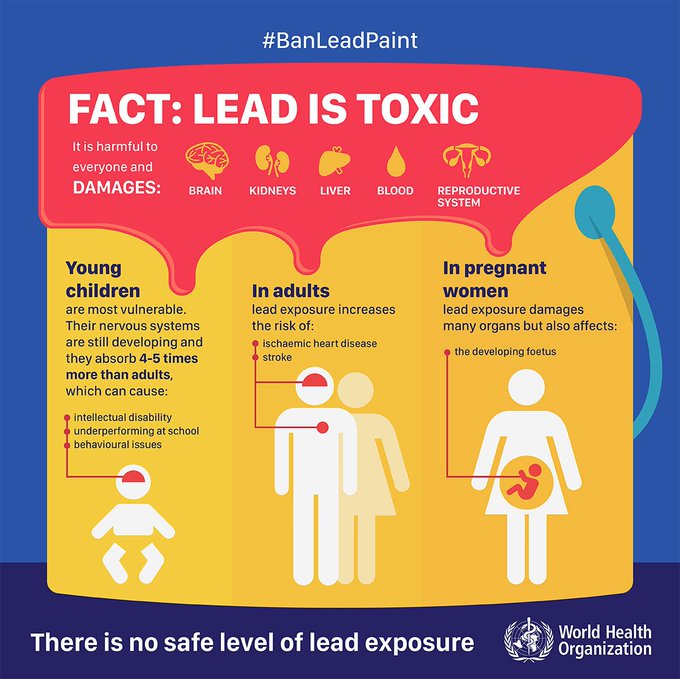
FACT: Lead is toxic.

It is harmful to everyone and damages:
-Brain
-Kidneys
-Liver
-Blood
-Reproductive System#BanLeadPaint!


1,370
12:22 PM - Oct 23, 2017
Twitter Ads info and privacy
1,365 people are talking about this


“Lead paint represents one of the most widespread sources of lead exposure to infants and children. Yet lead paint still lurks in homes, in schools and on toys.”

Decaying lead paint can contaminate soil or dust, meaning young children can ingest it while playing on the ground.

Lead is stored in the teeth and bones and accumulates over time, affecting multiple body systems. It is distributed to the brain, liver, kidney and bones.

As young children’s nervous systems are still developing, they can absorb up to five times more lead than adults.

Dr. Neira explained that lead impairs childhood brain development, which could lead to reduced IQ.

“It will result as well in behavioural changes such as shortening of attention span, increased anti-social behavior, and sometimes even reduced educational attainment”, she added, noting that the impacts can extend into adulthood.

WHO is using International Lead Poisoning Prevention Week of Action, 20-26 October, to mobilize for laws, regulations or enforceable standards to stop the manufacture, import and sale of paints that contain lead.

Many countries are currently establishing laws to reduce the level of lead in paint to below 90 parts per million (ppm): the lowest and most protective regulatory limit set.

Tuesday, October 15, 2019

One billion people have preventable eye conditions, increasingly linked to lifestyle choices -WHO 8 October 2019 Health

A staggering 2.2 billion people already suffer from eye conditions and visual impairment today, but the global need for eye care is set to increase “dramatically”, with lack of exercise a key factor. While welcoming recent successes in eliminating common conditions such as trachoma in eight countries, the World Health Organization (WHO) highlighted evidence indicating that eye problems are increasingly linked to lifestyle choices, including screen time.

Youngsters are among those at risk, WHO’s Dr Alarcos Cieza told journalists in Geneva:

“In children, one of the factors that may influence the increased number of children with myopia, is that children do not spend enough time outdoors. It is a trend that is already observed in some countries like in China”, she said. “But of course, it is a trend that we can predict in other countries if they are an everyday habit, especially with child populations.”
Eye ‘never relaxes’ indoors

The problem with staying inside, is that the lens in your eye rarely relaxes, WHO’s Dr Stuart Keel explained.

“When you’re indoors, the lens inside your eyes is in a complete flex state, or it’s flexed but when you’re outside, it’s nice and relaxed.”


At least 2.2 billion people have vision impairment or blindness
Over 1 billion could have been prevented or have still to be addressed: @WHO’s first ever World Report on Vision http://bit.ly/2ofvys3


Pointing to recent scientific data from China investigating the “clear link” between time spent outdoors and the delayed onset of later-stage short-sightedness, Dr Keel cautioned that studies on “near-task” activities such as watching video on a tablet computer, were “not as conclusive at this stage”.

According to the WHO’s World Report On Vision, the burden of impairment tends to be greater in low and middle-income countries.

Women also suffer disproportionately, along with migrants, indigenous peoples, and those with disabilities and rural communities.

“Eye conditions and vision impairment are widespread, and far too often they still go untreated,” said Dr Tedros Adhanom Ghebreyesus, WHO Director-General. “It is unacceptable that 65 million people are blind or have impaired sight when their vision could have been corrected overnight with a cataract operation, or that over 800 million struggle in everyday activities because they lack access to a pair of glasses.”

Population growth and ageing - along with lifestyle changes and urbanization - will also “dramatically increase” the number of people with eye conditions, vision impairment and blindness in the coming decades, WHO’s report shows.

One of the study’s main findings is that prevention is key, since at least one billion people are living with sight problems that could have been avoided with timely treatment.

Addressing this backlog of vision impairment or blindness owing to short and far-sightedness, and cataracts, will require $14.3 billion, the agency notes.

It points out that prevention is particularly important in low-income regions including western and eastern sub-Saharan Africa and South Asia, where blindness rates are on average eight times higher than in high-income nations.

The combination of a growing and ageing population will also “significantly” increase the total number of people with eye conditions, but this too could be turned around with preventative measures.

Typical conditions that could be treated if diagnosed early, include diabetic eye disease, along with cataracts and glaucoma.

“Vision impairment should not be seen as part of the ageing process,” Dr Cieza insisted, “because if you receive the appropriate care, for example, in the case of glaucoma, you can prevent the vision impairment associated with glaucoma, or if you receive cataract surgery, you can avoid the visual impairment associated with cataracts.”

High-quality eye care for all

Another key thrust of WHO’s report is that high-quality eye care should be accessible to everyone, regardless of their income and location.

To do this, treatment should be included in countries’ national health plans as an essential part of the overall aim of achieving effective universal health coverage, it says.

For the most part, eye conditions that can cause vision impairment and blindness –cataracts, trachoma and refractive error – are the main focus of national prevention strategies.

Nevertheless, other eye conditions that do not typically cause vision impairment – including dry eye and conjunctivitis – should not be overlooked, WHO says, noting that they “are frequently among the leading reasons for presentation to eye health care services all countries”.


Sunday, October 6, 2019

WHO and UNICEF in campaign to protect 1.6 million in Sudan from cholera


UN agencies are working with the authorities in Sudan to protect more than one million people from cholera, an infectious disease which can kill within hours if left untreated.


So far, there have been 215 confirmed cases, including eight deaths, since an outbreak was declared in Blue Nile state on 8 September.

The World Health Organization (WHO) and the UN children’s fund, UNICEF, will support an oral cholera vaccination campaign aimed at covering 1.6 million people there and in neighbouring Sinnar state.

The first round is expected to start in mid-October, targeting everyone above one year of age, including pregnant and lactating women.

“Sudan has bad health infrastructure and a dilapidated safe water and sewage system. Re-occurring floods have further led to polluting water sources. All of these factors heighten the risk of cholera and other diarrheal diseases and threaten to cause a wide spread if no immediate response interventions are not adopted”, WHO Spokesperson Tarik Jasarevic said in Geneva on Tuesday.

WHO, alongside UN agencies and local and international partners, also are preparing to respond to potential outbreaks in six other at-risk states in Sudan.

Some $10 million to $15 million will be needed to contain the outbreak in the coming months to address issues such as health, safe water, safe nutrition and access to quality care services, in addition to mobilizing communities and youth.

WHO recalled that nearly 37,000 cases of cholera and/or Acute Watery Diarrhoea were recorded in 18 states in Sudan between August 2016 and March 2018. Overall, 823 people died, 15 per cent of whom were children under-five. The UN health agency is using lessons learned from the 2016-2018 outbreak to inform current preparedness and response measures.

Cholera is caused by ingesting food or water contaminated with a bacterium called Vibrio cholorae, resulting in watery diarrhoea and severe dehydration.

The disease is preventable and can be eliminated through provision of clean water and sanitation facilities, combined with satisfactory hygiene conditions, according to WHO information.

1 October 2019

RUSSIA: Strict alcohol laws which cut intake more than 40 per cent in Russia, linked to historically high life expectancy -WHO

Studies show that more than three million people across the world died as a result of alcohol misuse in 2016, more than three quarters of them men.

Russian alcohol consumption decreased by 43% from 2003 to 2016, a World Health Organization (WHO) report says.


1 October 2019
Health


Strict laws put in place by the Russian authorities since 2003 have resulted in a significant drop in alcohol-related deaths nationwide, a report from the World Health Organization (WHO) revealed on Tuesday.


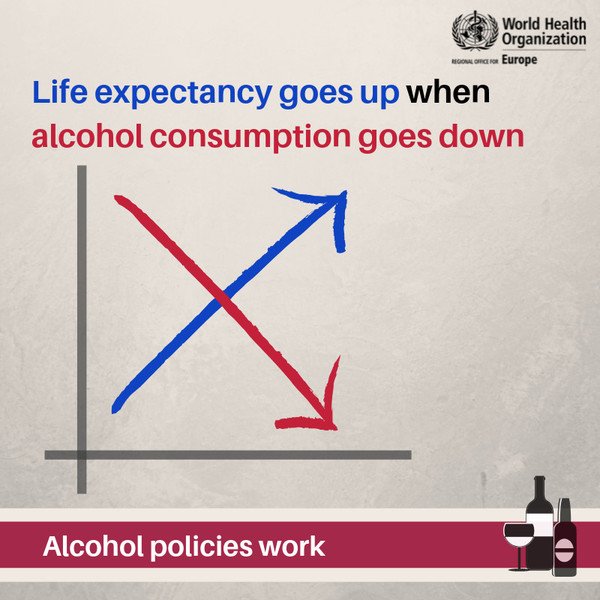
The impact study on the effects of "alcohol control measures on mortality and life expectancy", shows that the amount of alcohol consumed per person fell sharply by 43 per cent, between 2003 and 2016.

Following concerted efforts by the Russian Federation, a plunge in alcohol consumption has been linked to a rise in life expectancy. Find out how in the thread and read the report http://bit.ly/2nakPyA


Russia, says the WHO, has long been considered one of the world’s heaviest-intake countries, with consumption patterns described as “hazardous”, and associated with some of the highest levels of alcohol-related deaths.

The worst period in recent times came during the 1990s and 2000s – described by the WHO as “Russia’s mortality crisis” – when, according to research, one in every two men of working age, would die prematurely because of alcohol abuse.

Russia’s alcohol control measures, which have seen a dramatic decline in the consumption of homemade, smuggled or illegally produced alcohol, are being credited with helping average life expectancy in the country to reach a historic high in 2018, at almost 68 years for men and 78 years for women.

“These results show that measures such as the introduction of monitoring systems, price increases and limited alcohol availability, work to save lives and health system costs”, said Carina Ferreira-Borges, from the Alcohol and Illicit Drugs programme at WHO Europe.

Many of the policies implemented by the Russian authorities to curb alcohol consumption have been recommended by the WHO: these include raising taxes on alcohol, and introducing a minimum unit price on vodka and other alcoholic drinks; introduced a real-time tracking system on the production and sale of alcohol; and curbing the availability of alcohol in some regions, coupled with strict policies on alcohol-free public spaces, such as parks and recreation areas.

The WHO hopes that the success seen in Russia will spur other countries to implement effective alcohol policies, in order to reduce the major health and economic burdens stemming from alcohol abuse, and improve the life prospects of their citizens.

Friday, September 6, 2019

UN health agency welcomes Facebook pledge to stop vaccine misinformation from going viral

The World Health Organization is working with Facebook to address the proliferation of misinformation about vaccines on the social media platform.

5 September 2019
Health


The World Health Organization (WHO) on Thursday welcomed Facebook’s pledge to ensure users can separate fact from fiction when it comes to vaccines, across its platforms from Facebook Search, to Groups, Pages and forums.


Following months of discussions between WHO and Facebook on the spread of inaccuracies when it comes to immunization, the social media giant has vowed to direct millions of users to “WHO’s accurate and reliable vaccine information in several languages, to ensure that vital health messages reach people who need them most”, WHO Director-General, Tedros Adhanom Ghebryesus said in a statement.

“Vaccine misinformation is a major threat to global health that could reverse decades of progress made in tackling preventable diseases”, WHO warned. Deadly and debilitating diseases such as diphtheria, hepatitis, polio and measles can be effectively prevented through vaccination.

WHO ranks vaccine reluctance, or hesitancy, among the top ten threats to global health in 2019, citing the recent resurgence in Measles this year, which saw a 30 per cent increases in cases worldwide.


Major digital organizations have a responsibility to their users—to ensure that they can access facts about vaccines and health -WHO Director-General

With the anti-vaccination movement gaining momentum online, immunization rates have plummeted globally as much in wealthy areas as in developing countries—media reports have cited vaccination numbers in California’s Los Angeles as low as those in Chad and South Sudan.

WHO estimates that Immunization prevents 2-3 million deaths per year, and additional illnesses and disabilities from 26 vaccine-preventable diseases.

Mr. Ghebreyesus made it clear that “major digital organizations have a responsibility to their users—to ensure that they can access facts about vaccines and health.”

“It would be great to see social and search platforms come together to leverage their combined reach,” he maintained.

Just last month, the social media platform Pinterest announced it would restrict vaccine search results only to major health groups, including WHO, and the US Center for Disease Control and Prevention (CDC).

“Digital actors,” should do more to ensure the world knows “that #VaccinesWork,” WHO said, highlighting the theme of this year’s World Immunization Week, celebrated in April.

The aim is to support innovation that backs healthy behaviours, the Director-General said, “to save lives and protect the vulnerable,” adding that many children have parents who fully support vaccination as a key health measure, but “currently lack access to these life-saving tools.”

The move by Facebook “must be matched by tangible steps by governments and the health sector to promote trust in vaccination and respond to the needs and concerns of parents”, Mr. Ghebryesus stressed.

#ASEAN2017:

#ASEAN2017:
Presidential Communications Operations Office – Committee on Media Affairs and Strategic Communications (PCOO – CMASC) in partnership w/ Asia Society Philippines & Asian Institute of Management (AIM) hosted the ASEAN 2017 Dialogues held 11 July 2017 at AIM, Makati, Philippines. Attending the dialogue is Amb.Zara Jane Juan, Convener , Climate Change Peace Building for United Nations Sustainable Development Goals (UNDSG) of sailing for peace United Nation's International Day of Peace Vigil MALUSOG ANG PINOY! United Nations Friends Photo Credit: Aloy Menez

Senator Angara with Ambassador Zara Jane Juan

Senator Angara with Ambassador Zara Jane Juan
@NCCA